WELL WATER 101

Well Water Solutions
Specialized Well Water Treatment For Northern California Homes, Ranches & Rural Properties
Because every well is different, proper water testing is an important part of determining the right system for your home. Well water can contain a variety of minerals, odors, and contaminants that affect everything from water quality and staining to appliances, plumbing, taste, and everyday comfort.
Our testing process helps identify common well water issues such as:
- Iron staining
- Sulfur / rotten egg odors
- Manganese
- Hard water minerals
- Tannins
- Sediment
- pH imbalance
- TDS (total dissolved solids)
- Problem well water conditions
Based on your water results, we help recommend the proper treatment solution for your home, ranch, or property.
Our primary well water treatment systems include:
Air Injection Oxidation (AIO) Iron Breaker Dual Tank Well System -
An AIO system — which stands for Air Injection Oxidation — is a specialized well-water filtration system designed to treat common groundwater problems like iron, sulfur odor (“rotten egg smell”), manganese, staining, and certain taste or odor issues without using chemical injection. In the water treatment world, it’s often considered the simpler, lower-maintenance cousin to a hydrogen peroxide injection system.
Instead of injecting an oxidizing chemical like hydrogen peroxide, an AIO system uses air — literally oxygen — to create an oxidation chamber inside the filtration tank. That oxygen reacts with contaminants in the water, allowing them to be filtered out before the water reaches the home.
The reason AIO systems became so popular is because many homeowners want strong well-water treatment without dealing with chemical tanks, injection pumps, or solution refills. It’s a cleaner, simpler, modern approach for moderate iron and sulfur conditions.
Here’s how an AIO system works in detail:
The system contains a control valve mounted on top of a mineral/media tank. Inside that tank is special filtration media. At the very top of the tank, the system maintains a compressed pocket of air.
When untreated well water enters the tank:
- The water first passes through the air pocket
- Oxygen in that air chamber reacts with dissolved contaminants
- Iron oxidizes from dissolved ferrous iron into solid ferric iron
- Hydrogen sulfide gas (sulfur smell) oxidizes and breaks down
- Manganese begins oxidizing as well
This oxidation process changes contaminants from dissolved forms into particles that can actually be trapped by the filter media below.
After oxidation occurs:
- The water travels through the media bed
- The media captures the oxidized contaminants
- Cleaner water exits into the home
The system periodically backwashes itself automatically to flush out the trapped iron, sulfur particles, manganese, and debris.
That automatic backwashing process is one of the key parts of the system:
- Water flow reverses direction
- The media bed expands and cleans itself
- Contaminants are flushed to drain
- The system rebuilds the air pocket afterward
- That’s why AIO systems are often called “self-cleaning” or “chemical-free oxidation” systems.
An AIO system primarily targets:
- Iron
- Sulfur odor
- Manganese
- Taste/odor issues
One of the biggest advantages of AIO systems is simplicity.
Compared to peroxide injection systems:
- No chemical solution tank
- No injection pump
- No peroxide refills
- Fewer moving parts
- Lower maintenance
- Often lower installation cost
That’s why people sometimes call it the “entry-level advanced well-water system"
AIO systems work well with the following conditions :
- Iron levels are moderate
- Sulfur odor is moderate
- Water flow rates are manageable
- Bacteria/slime issues are minimal
When water conditions become more severe:
- Heavy sulfur
- Strong odor
- Iron bacteria
- Organic contamination
- Slime
- High iron loads
- Difficult pH conditions
That’s when installers often step up to hydrogen peroxide injection systems because peroxide is a much stronger oxidizer than air alone.
An AIO system uses oxygen from air to naturally oxidize and filter contaminants.
A hydrogen peroxide system uses a stronger oxidation process for tougher water problems.
That’s why the two systems are closely related:
- Same general goal
- Similar oxidation concept
- Different strength levels
In many ways:
- AIO = simpler, cleaner, lower-maintenance
- Peroxide injection = heavier-duty, more aggressive treatment
For marketing purposes, AIO systems are attractive :
- Chemical-free
- Air-powered oxidation
- Self-cleaning
- Low maintenance
- Removes sulfur odors
- Removes iron staining
- Protects plumbing and appliances
And visually, AIO systems also look very professional because they’re typically clean single- or dual-tank setups with digital control valves, which gives them a modern “premium equipment” appearance in garages, pump houses, and utility rooms. AIO Iron Breaker systems are trusted by thousands of home owners across Texas, if you have any questions call RJ at (530)-418-5549. American First.
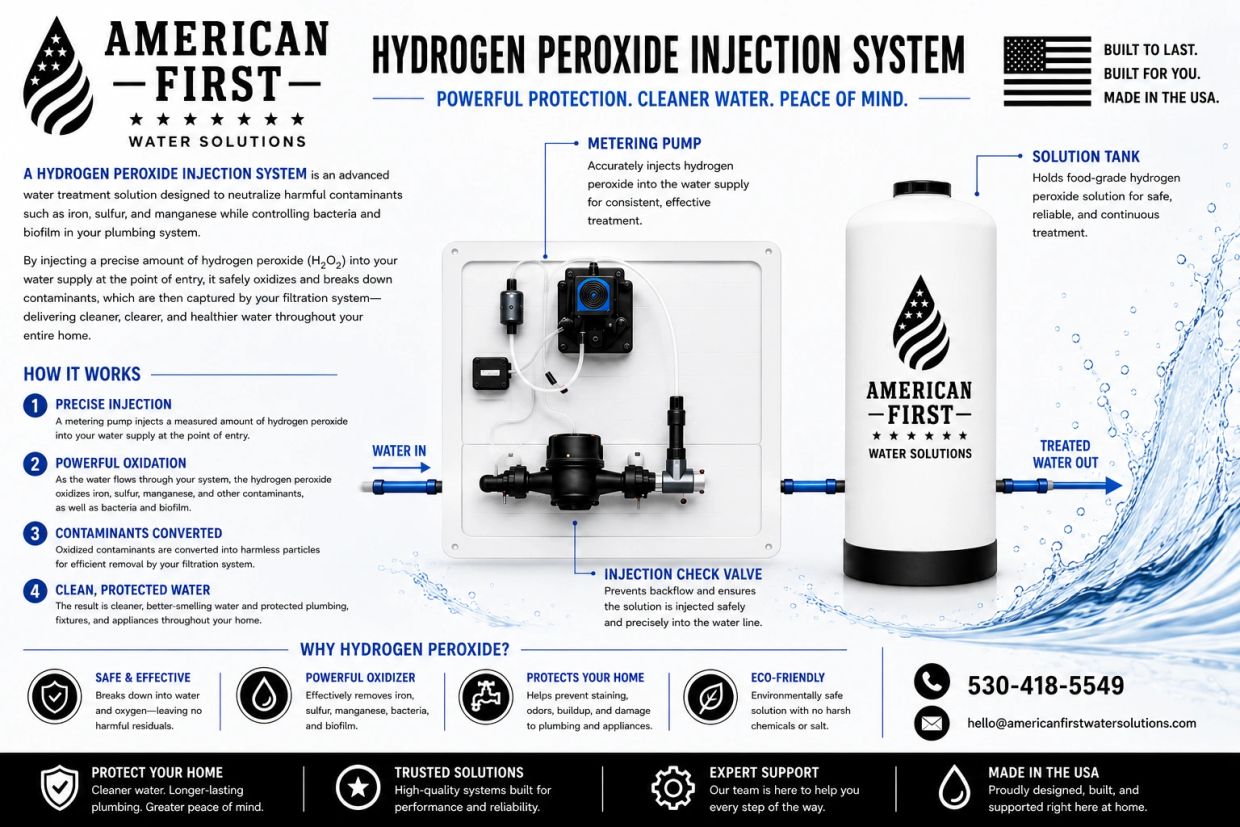
Hydrogen Peroxide Injection Dual Tank Well System-
A hydrogen peroxide injection system is an advanced well-water treatment setup designed to treat difficult water problems like sulfur smell (“rotten egg” odor), iron, manganese, bacteria, slime, staining, and organic contamination before the water enters the home. It works by injecting a controlled amount of food-grade hydrogen peroxide directly into the incoming water line, where it begins an oxidation process that changes dissolved contaminants into particles that can then be filtered out.
The reason these systems are so effective is because hydrogen peroxide is an extremely powerful oxidizer. When it enters the water, it reacts with contaminants almost immediately. Sulfur gases are neutralized, dissolved iron begins turning into solid particles, manganese oxidizes, and many bacteria or slime-related issues are disrupted or destroyed. After the peroxide has enough contact time to react with the water, the contaminants are captured by filtration media such as catalytic carbon, multimedia filtration, or specialty well-water systems.
One of the biggest misconceptions is that hydrogen peroxide is “adding chemicals” to the water in a dangerous way. In reality, properly sized residential systems use very controlled doses, and hydrogen peroxide naturally breaks down into oxygen and water after the oxidation process is complete. The filtration stage afterward is what polishes and finishes the treatment.
These systems are especially popular for:
- difficult water conditions identified during testing
- certain Ranch properties
- Homes with severe sulfur smell
- Heavy iron staining
- Slime bacteria issues
- Bacteria-related issues
- Organic contamination
- challenging well water situations
Compared to older chlorine systems, peroxide systems are often viewed as:
- Cleaner smelling
- Lower odor
- More homeowner-friendly
- Better tasting
- Less harsh on plumbing
- More modern and premium
At American First Water Solutions, our goal is to help Northern California homeowners better understand their water and provide dependable, customized solutions designed to improve everyday water quality throughout the entire home.
American First Water Solutions
Northern California Well Water Specialists
WELL WATER 101